
A four-corner approach to leading grown adults without babysitting them.
Last week was about you getting your head right. This week is about your people. Spring arrives, the phones wake up, and suddenly half the district wants everything yesterday. This is the business you chose to be in. The question is whether your people meet the pressure with clarity and composure, or with that familiar cocktail of hurry, frayed tempers, and preventable errors.
Leadership, at this point, does not stem from a glamorous pep talk poster in the smoko room, it derives from the routine, unglamorous craft of creating the conditions in which competent adults can do good work at speed.
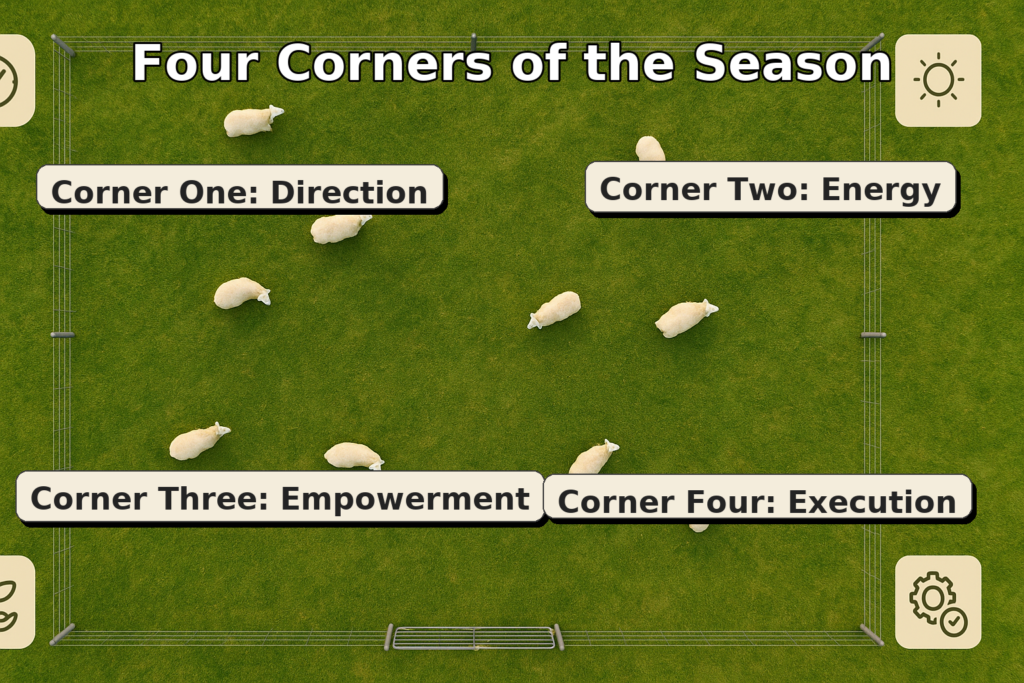
A useful way to keep yourself ahead of the curve is to think in four corners: direction, energy, empowerment, and execution – and to walk that fence line daily. Miss a corner and the stock (processes) will go wandering.
Corner One: Direction (know where you’re heading and why)
Before the weather window opens and chaos proposes itself as a strategy, call your people together and state the season’s direction in plain language.
What, specifically, constitutes success for this outfit over the next eight to twelve weeks? On-time services? Fewer grumpy call backs? More productivity output? Choose the few measures that matter most to the business, connect them to a purpose everyone can recognise, and make them visible. People are astonishingly resilient when they know what game they’re in and how the score is kept.
Then translate the purpose into immediate, action. It’s not “excellence” in the abstract; it’s today’s paddocks, today’s scheduling, tomorrows first job on the scheduler. A clear why and a practical what will keep a crew steady.
Corner Two: Energy (set the tone)
Contrary to folklore, atmosphere is not a mystery; it’s a managerial artefact. The leader’s demeanour is the most contagious thing on site. If your voice stays measured when a machine throws codes or a client changes their mind, the temperature in the team stays stable. If you react in an overly exasperated way, you will get theatre in return.
The job here is to be deliberately un-dramatic. Create a professional climate: brisk, civil, slightly irreverent about inconvenience, and respectful of effort. A quick “good catch, mate” for the person who headed off a mistake at 3 p.m. does more for output than any end-of-season speech.
If morale sags – as it often does as the weeks drag on – the remedy is not fireworks but oxygen: a brief reset, a clear next step, and a reminder of progress already made. Adults don’t need cheerleading. They need to see that the ship is being steered.
Corner Three: Empowerment (grow capacity)
Many owners try to outrun complexity by personally absorbing it. It’s heroic, and it fails. The alternative is to develop people in the work, which is to say: delegate with context and reasoning to the task, not just tasks for tasks sake.
Your entire goal here should be to become progressively unnecessary. Give someone ownership of an outcome that matters, if they ask for an answer you could give in three seconds, resist the reflex and answer with a question that forces them to think.
Feedback, in this corner must be brief, timely, and specific: what worked on that job; what to adjust on the next one. Soon you will wonder why you carried so much yourself.
Corner Four: Execution (deliver under pressure)
Execution is where good intentions either harden into results or evaporate in the heat. The fourth corner is disciplined delivery: breaking complex jobs into steps, removing obstacles, and maintaining attention on the few priorities that actually move the needle.
Short, regular reviews to keep accountability high without sliding into micromanagement. When time’s tight and the client’s watching, you keep the main thing the main thing. That’s not micromanaging; that’s keeping the wire tight so the whole fence holds. This quadrant is your anchor: it keeps teams clear, efficient, and safe while still hitting outcomes.
Shifting corners as the season changes
You don’t pick a favourite corner and stay there. You move. When uncertainty spikes, lead with direction: restate the plan and the first step. When tempers fray or people flag, lean on energy: lower the noise, show progress, protect the basics. When you can see the same bottlenecks every afternoon, switch to empowerment: hand over outcomes and coach in real time. When the window opens and the job is there to be taken, tighten execution and get on with it.
Your own bias
We all have a comfort quadrant:
– Some are operators who revel in the bustle of today and neglect the horizon
– Some are strategists who draft elegant plans that they never execute
– Some are natural encouragers who quietly dodge hard calls
– Some are drill-sergeants who deliver, and leave a trail of resignation letters.
Pick the corner you over-index on. Then pick one you’ll work to strengthen for the month.
Balance the team, not just the boss
Finally, stop hiring or encouraging replicas of yourself. Map your crew against the four corners. Do you have someone who instinctively sees around corners, someone who steadies the room, someone who grows others, someone who anchors the job when it gets late? The work goes sweeter when the team – not just the boss – covers all four corners.
The point of all this is?
You cannot control the rain, the parts delivery, or the client with a flexible relationship to time. You can control the environment people work in: a clear direction, a professional tone, and disciplined delivery. Walk those four corners daily. Fix what’s loose. You’ll get the hectares and the invoices, certainly.
More to the point, you’ll finish with a crew that’s still sharp, still speaking, and still inclined to come back next season – which, in this business, is the nearest thing to compound interest.